
 |
 Latest Entry Latest Chapter All Chapters Landmark Entries '97 Trail Journal Search |
 |
 |
 |
 |
|
|
 Canadian Wheat What time do you leave Lalibela if you're headed for Bahir Dar? Right. The same time you leave every town in Ethiopia to go to any other town in Ethiopia. We got up at five to be at the bus station by six in the morning. Bahir Dar is really more of a ten hour trip from Lalibela, but there's no direct bus. You have to change halfway and, of course, when you arrive at the junction town you've missed the six a.m. bus. "A nice Indian couple having an early lunch." While waiting another bus came by going the wrong way. The local kids did what they do whenever a bus passes. They swarmed around it, wearing cardboard boxes slung around their necks with twine and containg candies, tissues and whatever else they think traveling Ethiopians will want. From inside the bus I'd always viewed these kids as a bit of an annoyance. Loud and excitable, they were another bothersome part of travel in Africa. "He wanted to practice his English." While reciting page and verse from his battered textbooks we got an idea of life as a "box boy." He buys his goods at the local market, puts them in his box, and makes
The bus was gonna be a problem. Not only would it most certainly be hermetically sealed and vomit-ridden, it didn't even go very far before stopping for the night. And it would be at least three hours before it arrived for us to get on. "We negotiated our way into the wheat truck." The "checkpoint" on the way out of town was really just a cop looking for a bribe. The driver stuck his head in the back and said the cop wanted something like fifty birr. We said hell no.
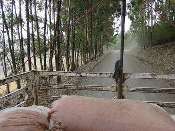
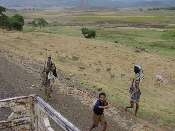
"We ran down the road ahead of the truck." we were sitting on top of, of all things, a few tons of Canadian wheat... or so it said on the huge sacks. It was an interesting way to cross a good chunch of Ethiopia and far, far better than riding in the barf bus. The truck even carried us much farther than the bus would have, going all the way to a junction town just a couple of hours from Bahir Dar. When it started raining the driver completely sealed the tarp covering the cargo so we couldn't see out. We rode for hours with no idea what was going on outside. Around sunset the driver stopped and opened the tarp. He wanted to show us something. The landscape had changed from mountains to rolling fields with the exception of a huge monolith soaring up out of the plains to the side of the road. The driver said, "Blah blah blah... Ethiopian history... Blah blah blah... we go." He really said the "Blah blah blah." When we arrived after dark he even got out to point us toward a hotel then turned the truck around to retrace the mile or so he'd drive out of his way to drop us in town. Nice guy. "Two of the most beautiful people we'd seen our entire trip." Matt and I had agreed that the Ethiopians, while quite annnoying, tended to be signifigantly more attractive than any people we'd seen up to that point. Still, it's not often that you see amazingly attractive people in the hinterlands, but these two were the stunning exception. I seriously think a couple of headshots sent the right agent would've had them on the next plane to New York. But, as happens so often, they got off the bus in what seemed the middle of nowhere and began carrying their belongings down a dirt path leading to the horizon with no town or houses in sight. Bahir Dar lies beside a lake whose name I can't remember, but it's the one that's the source of the Blue Nile. Dotted along the lake just off Bahir Dar are islands upon which are monasteries that are hundreds of years old... most dating from the 1400's. A guy named "Fish" told us he'd arrange for us a boat tour of the islands that would be way cheaper than the offical boats run by the government. "We'd have to walk over a mile back into town."
The monasteries were interesting but not mind-blowing. There were vivid murals of biblical stories, many of them well-preserved originals. One monastery didn't allow women to enter the island. Becky and Justin waited on the boat while Matt and I went up the hill. Looking back I suppose this wasn't too nice of us to leave them sitting around but we didn't think at the time. "The birthday cake miracle." We were camping beside the lake at a reasonably nice hotel. That night I would sneak into the empty hotel room where we'd been allowed to use the shower. I was feeling so bad I couldn't bear spending the night in the tent. We started preparing ourselves for one more grueling bus ride to Gonder, only a day from the Sudanese border. posted at 7:41am EST |
 Previous Entry