
 |
 Latest Entry Latest Chapter All Chapters Landmark Entries '97 Trail Journal Search |
 |
 |
 |
 |
|
|
 Desert Train There are two ways to go north from Khartoum toward Egypt. Neither is pleasant. You must cross the entire Nubian desert on your way to Wadi Halfa, near the Egyptian border. It's some of the most remote country in Africa, maybe the world. The first strategy for heading north takes nearly a week and involves at least six different buses or rides in pickup beds. A guy who did it coming south said for most of the journey there is no road, only a track through the sandy desert. Four extra men ride the bus and carry shovels. When the vehicle bogs down about every fifteen minutes, they climb down to dig the wheels out of the mire. Oh, and it's unbearably hot. Having had more than enough experience with hot buses and pickup rides we opted for strategy number two: the desert train. I guess in Sudan you could just call it "The Train," since Wadi Halfa is one of only two destinations still served by the rusting Sudanese Railway. "Dirty. Dusty. Long." The train's departure time of eight pm came and went. In the station filled with locals going the same way as us we felt a little like cattle being corralled for slaughter, waiting our fate. The only other white person in the joint was Dan, a teacher from England who'd just finished several months of volunteering and was headed to Egypt on his way home. The train finally arrived at the station around ten.
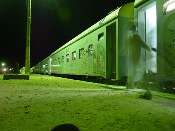
"There she is, boys." Matt said, "The old shitbox herself." "We climbed aboard with no idea what to expect." We quickly learned that in Sudan, first class does not entitle you to a bed... not even on a fifty-two hour journey. The six non-reclining seats faced each other, three facing forward and three back. They were covered in a cheap velour-like fabric that looked like the upholstery on American old people's furniture. It was brown with country scenes involving barns. "Exposed electrical wires and a bare fluorescent light tube."
Shortly after departing Khartoum we realized why the journey takes fifty-two hours. Sudan's a big country, the largest in Africa. But we were already farther north than halfway. The train takes over two days because it goes about thirteen miles per hour... when it's working properly, which we discovered isn't often. "You may know this Osama guy." Bedtime brought an interesting scene in our cabin. One of the older guys took his blanket and rather matter-of-factly bedded down on the hallway floor outside the cabin. Another went to the area at the back of the coach near the "bathroom." This left room for the rest of us to stretch our legs across onto the seat on the other side. Still not the least bit comfortable we were at least able to sleep.
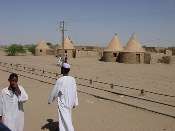
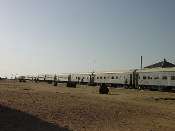
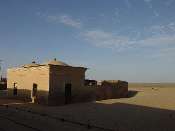
"There was no locomotive." We were in about the most remote place I can imagine. Known only as "Junction 10" it's where the railway branches, one track following the Nile as it dips back south, the other heading north into the heart of the Nubian Desert. The last town was hours behind us; the only buildings in sight were the three or four dirt shacks that were probably used by the railroad years ago. Desert sprawls to the horizon in every direction. It is utterly quiet. As morning rolled on and there still was no locomotive for our train people squatted in whatever shade they could find. Matt and I walked into the desert toward some mountains that were just on the edge of the horizon. It's striking how the desert distorts your perception of distance. After walking five minutes away from the train it still seemed to be just over our shoulder... so close. Matt had ventured off in front of me and after a few minutes he looked like a big dot on the sand. Had I not known it was him I might have thought he was a lone shrub or pile of rubble. "How they got there I haven't the slightest idea." A long walk back to the train brought the discovery of the biggest drawback to train delays in Sudan. I'm sure you'll understand with just the statement that the "toilets" are simply rooms with a hole through the floor. I'll just give you a moment to get a good mental picture. By the time we'd been stranded for six hours things had begun to pile up quite noticeably. This, however, did not stop people from adding their contribution to the collection. I also noted that people didn't seem very put off by the piles; they'd stand and have conversations not five feet from the affected area. I guess in a place like Sudan it becomes part of the landscape.
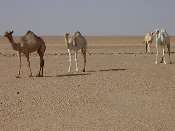
A family of camels sauntered by around eight to see what all the commotion was about. We went over to say hello and marvel at the giant animals. By mid-morning word reached Junction 10 that a new locomotive had left the town a few hours to the south and was headed our way. We'd be moving again before noon. Skeptical but optimistic we kept looking to the southern horizon for sign of our new ride north. The new locomotive, looking no less battered than the first, rattled into place to our front and we were moving shortly thereafter. We reminded ourselves that on the Sudanese Railway, being stopped is really only marginally slower than full speed. So we hadn't lost much time after all. "My face, hair and clothes were quickly caked." By later that day the population of our cabin had dropped to three: Matt, me and an old Nubian guy going home to Wadi Halfa. We didn't talk to him, assuming he spoke no English. He shattered our conceptions, though, when he saw Matt reading Robinson Crusoe and asked in decent English if he was enjoying it. The old guy told us he'd read not only Robinson Crusoe, but Huckleberry Finn, Tale of Two Cities and a list of literature of which I'd only read a few. We were shocked. He would go on talking most of the day, enthralling us one minute, boring us to death another. He asked us about America and told us all about Sudan. He wasn't a fan of the current government, but was afraid to talk about it much. He would frequently glance around and slide our door shut before talking politics. "Relics of colonialism."
The second sunset of our journey saw us tantalizingly close to our destination. Wadi Halfa was barely seven hours away at our current speed. If we could just avoid breaking down again we could be there shortly after midnight. Every time the train slowed or the engine sputtered, we were filled with the dread of spending another night and day on the train. "Only three hours behind the time we'd been promised." The old man from our cabin was met by his family in a 4x4 and offered us a ride. It seemed the whole family had waited up till after midnight before piling into the vehicle to meet the train. So much family that there was barely room for our friend, much less us. This is what a literate, intelligent man sees in a place like Wadi Halfa. They dropped us at a hotel with dirt floors, pit toilets and cold water bucket baths. We didn't care. It was a place to wash off the grime, stretch out, get the train rumble out of our heads and rest before continuing our journey on the Lake Nasser ferry north into Egypt. posted at 4:27am EST |
 Previous Entry