"Just think Jane Goodall with cats instead of primates."


"They're in the air for something like 10 feet between each stride."


"It would be easy to say the thing probably ought to be extinct."


"Farmers tend to shoot every Cheetah they see."


"Some Jackals chewed off part of my sandals as I slept."


"This is a place you just have to see the photos of."
Which Way? August 9, 2003 Etosha National Park, Tsumeb, Namibia
Living Eden Etosha National Park, Tsumeb, Namibia
Wednesday August 13, 2003
PBS called it "one of Earth's last edens." I'm not quite as given to that kind of description, but Namibia's Etosha National Park was very cool.
Being a tourist in Namibia ain't cheap. There's no public transportation though Etosha, so you either go on a tour or drive yourself. The cheapest tours were not much less than $100 a day, so Matt and I decided to rent a car and do it ourselves. Still expensive, but we saved a bit of money and had some independence from the schedule-drive tour scene.
"A little Cheetah pilgrimmage." Before Etosha, though, I wanted to make a little Cheetah pilgrimmage. About a year ago my television station
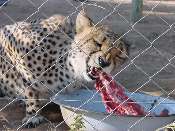
A Cheetah Chows at CCF
in Cincinnati did a documentary about the Cincinnati Zoo and its close ties with the Cheetah Conservation Fund in Namibia. Our chief photographer and one of the main guys from the Zoo came over here to shoot it. I did the 30-second promo that ran to promote the documentary before it aired.
Since I was coming so close, I couldn't miss checking out in person what I'd spent so much time looking at on a television screen.
"Miles and miles of nothingness." The CCF lies about 25 miles down a dirt track off the main road toward Etosha. We thought we were lost as we passed miles and miles of nothingness and even had to let ourselves through a gate that was closed across the road.
But we found it, and in the course of two visits before and after Etosha, we learned a lot about Cheetahs.
"It seems very well funded." Dr. Laurie Marker runs the place. She's from Oregon and you can safely just think Jane Goodall with cats instead of primates. She's very outgoing and obviously has done a great job selling the world on the value of her program. It seems very well funded.
Unfortunately, though, the Cheetah has a ton of problems. It would be easy to say the thing probably ought to be extinct.
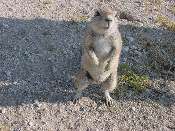
A Ground Squirel at Etosha Says Hi
Even though it's the fastest animal on the face of the earth, it often can barely survive in the wild. Overgrazing of fields has caused trees and bushes to grow in what was once open savannah. It can't chase what it can't see. That and farmers tend to shoot every Cheetah they see.
"As genetically similar as you are to your cousin." So CCF is trying educate farmers that it usually isn't Cheetahs that are eating their livestock. They even train and donate guard dogs that can scare off Cheetahs that threaten farmers' animals. A huge effort to save an animal that was nearly killed off in the last ice age. (So few were left to re-establish the population that every Cheetah in the world is as genetically similar as you are to your cousin.)
But as hopeless as they may ultimately be in the wild, they are fantastic to see run. CCF has a Greyhound track-like contraption that runs a piece of cloth around a pen for the Cheetahs to chase. They weren't even really trying very hard and weren't near their top speed of almost 70 miles an hour, but they're so graceful. They're in the air for something like 10 feet between each stride.
"It looks like nothing should live here." But there were more animals to be seen at Etosha. This is an interesting place, too. It looks like nothing should live here. It's desert and what looks like salt plain. Probably a quarter of the park is the "ephemeral pan," a lake bed that fills with water every decade or so. The only reason anything lives here is that there are underground reservoirs that bubble to the surface all over the park.
The campsites all have flood-lit watering holes next to them, so you can sit and watch the animals come and go all night. We saw a rhino just saunter out of the bush,
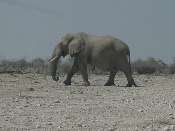
An Enormous Elephant Lumbers by Our Car
start drinking, and finally calmly walk back into the darkness. All while we sat like moviegoers behind the lights.
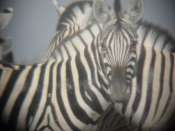
"The usual list of African animals." By the time we left, we'd seen the usual list of African animals. Elephants, Giraffe, Zebras, Rhino, Springbok, Gemsbok. And some Jackals chewed off part of my sandals as I slept.
We were both sick while we were there, so it could have been better. Matt actually turned out ot be worse off than me. His fever went over 102 at one point,
No Malaria!
accompanied by chills, sweats, muscle and headaches. These are the classic signs of Malaria.
"No Malaria in any case." After the staff was completely uninterested in helping us find the park's staff nurse we drove out to find one of our own. They took some blood and did the test and, after a drumroll, told us Matt probably had the flu. No Malaria in any case.
With that news and slight improvement in both of our conditions we decided to extend the car rental for a day and head for Soussesvlei. It's a spot in the middle of the Namib Desert that's surrounded by towering orange-red
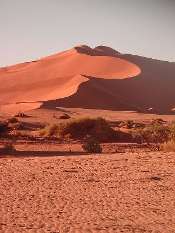
A Dune at Sousessvlei
dunes. Also impossible to reach without your own car or an organized tour.
"Parts of it are amazingly red." This is a place you just have to see the photos of. Parts of it are amazingly red. It's because the sand comes a river that had lots of iron. So basically a layer of rust formed around each sand grain. Then it got dumped at the mouth of the Orange River, carried north by the Benguala current, deposited on the Namibian coast, then blown inland by the winds. Now it makes mountains of sand in the desert. We watched the sunset from one of the dunes... along with a TV crew from Denmark.
Off now to Opuwo... a tiny town near the border with Angola. Matt has another connection there through a friend back home.